

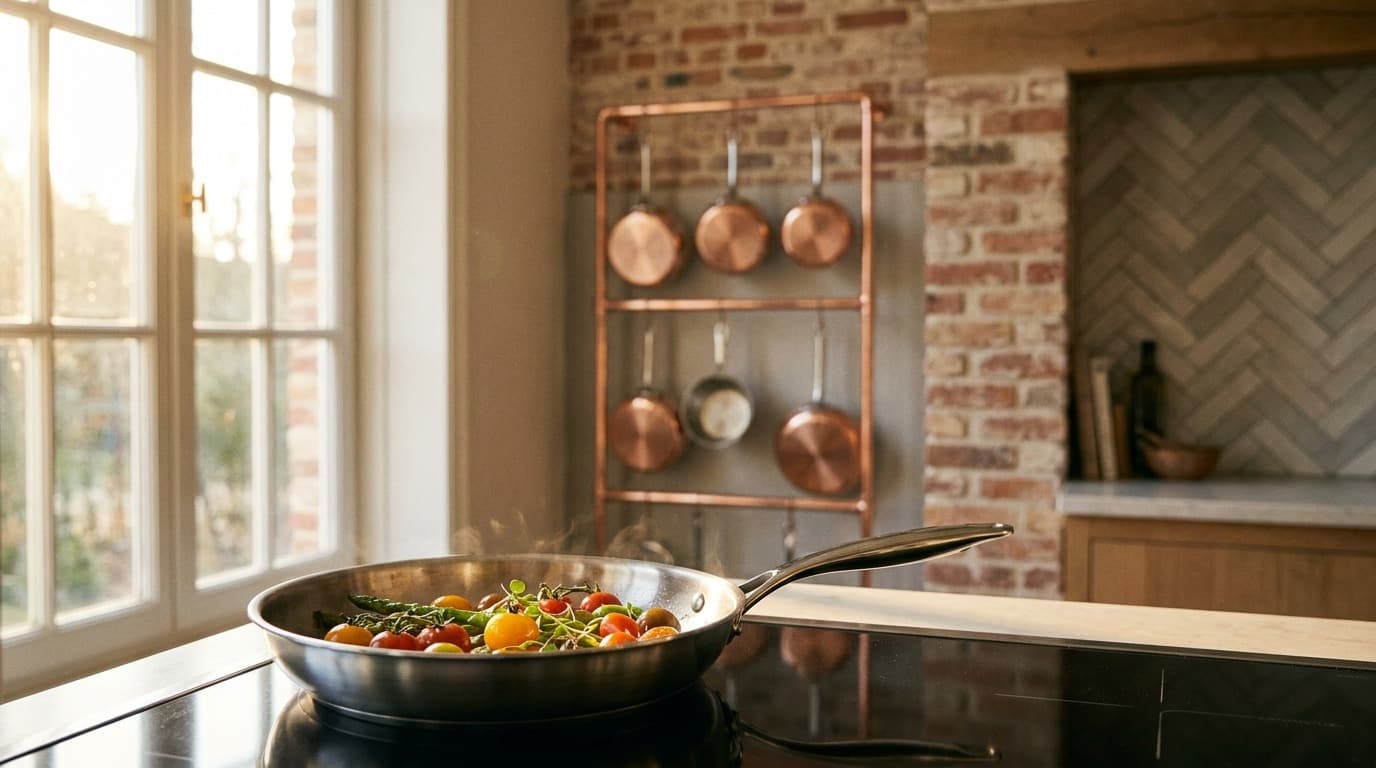
Die meisten Haushalte sollten sich für eine 28cm Bratpfanne entscheiden. Sie bietet die beste Balance zwischen Kochfläche, Hitzestabilität und Alltagstauglichkeit. Eine 20cm Pfanne eignet sich für Einzelportionen, eine 24cm Pfanne funktioniert gut für Paare, und eine 32cm Pfanne ist am besten für das Kochen großer Mengen oder große Familien geeignet.
Sie kochen gerade das Abendessen, und alles fühlt sich wieder einmal zu eng an. Das Hähnchen überlappt sich, Feuchtigkeit sammelt sich an, und statt zu bräunen, entsteht Dampf. Oder Sie wechseln zu einer größeren Pfanne, und plötzlich verteilt sich das Essen zu dünn und gart ungleichmäßig.
Bei KlonBerg entwerfen wir Kochgeschirr basierend auf echtem Küchenverhalten, nicht auf Katalognummern. Ein Muster zeigt sich immer wieder: Die meisten Kochprobleme entstehen durch die falsche Pfannengröße, nicht durch die falsche Technik.
Dieser Ratgeber löst diese Entscheidung in wenigen Minuten.
Was die Bratpfannengröße wirklich bedeutet
Die Bratpfannengröße bezieht sich auf den inneren Kochdurchmesser, nicht auf den äußeren Rand. Dieser Unterschied wirkt sich direkt auf die nutzbare Kochfläche aus.
Zwischen 20cm und 32cm:
- Die Kochfläche nimmt um ~35–40% zu
- Der Wärmebedarf steigt schneller als die Oberfläche
- Die Verdampfungsgeschwindigkeit von Feuchtigkeit ändert sich erheblich
Lebensmittel brauchen Oberflächenkontakt, um zu bräunen. Wenn sie sich überlappen, geben sie Dampf ab, anstatt scharf anzubraten.
Schnelldiagnose
Wenn Ihre Lebensmittel:
- dampfen statt bräunen
- in der Mitte ungleichmäßig garen
- mehrere Durchgänge für normale Mahlzeiten benötigen
ist Ihre Pfannengröße wahrscheinlich zu klein.
20cm Bratpfanne: Präzision für kleine Mahlzeiten
Eine 20cm Bratpfanne erhitzt sich schnell aufgrund der geringen thermischen Masse. Auf einem Induktionskochfeld erreicht sie typischerweise die Kochtemperatur (etwa 180°C) in etwa 60–90 Sekunden.
Am besten für:
- Mahlzeiten für 1 Person
- Frühstückszubereitung
- Einzelportionen
Reale Kochverwendung:
- 1–2 Eier
- 1 kleine Hähnchenbrust (120–180g)
- schnelles Gemüse oder Aufwärmen
24cm Bratpfanne: Ausgewogene Wahl für jeden Tag
Die 24cm Pfanne ist eine der am häufigsten verwendeten Haushaltsgrößen, da sie Wärmekontrolle und nutzbare Fläche ausbalanciert.
Am besten für:
- Paare
- kleine Haushalte
- alltägliches Kochen
Reale Kochverwendung:
- 2–3 Eier
- 2 Hähnchenbrüste (250–350g insgesamt)
- Gemüse für 2 Portionen
28cm Bratpfanne: Der vielseitigste Haushaltsstandard
Die 28cm Bratpfanne ist die flexibelste und am weitesten verbreitete Größe in echten Küchen.
Sie bietet etwa 30% mehr Kochfläche als eine 24cm Pfanne.
Am besten für:
Familien mit 3–5 Personen
die Zubereitung vollständiger Mahlzeiten
Gerichte mit gemischten Zutaten
Reale Kochverwendung:
- 3–4 Eier oder Omeletts
- 3–4 Hähnchenportionen (450–600g insgesamt)
- vollständige Pfannengerichte oder Saucen
Kontraintuitive Erkenntnis: Eine 28cm Pfanne schneidet bei alltäglichen Mahlzeiten oft besser ab als eine 32cm Pfanne, weil die Wärmedichte stabiler bleibt.
32cm Bratpfanne: Werkzeug für hohes Volumen
Eine 32cm Bratpfanne ist auf Kapazität statt auf tägliche Effizienz ausgelegt.
Am besten für:
- große Familien (5+ Personen)
- Meal-Prep-Kochen
- Kochen großer Mengen
Reale Kochverwendung:
- 4–6 Portionen pro Durchgang
- 700–900g gemischte Zutaten
- große Proteinmengen
Warum die Größe die Kochleistung verändert
Die Kochleistung skaliert nicht linear mit der Größe.
Eine 32cm Pfanne hat ~40% mehr Oberfläche als eine 24cm Pfanne, benötigt aber deutlich mehr Energie, um eine konstante Brattemperatur aufrechtzuerhalten.
Externe Referenz:
https://www.hse.gov.uk/food-safety/cookware-safety.htm
Dies beeinflusst:
- Hitzestabilität
- Bräunungsgeschwindigkeit
- Energieeffizienz
Der häufigste Fehler
Die meisten Menschen nehmen an, dass eine größere Pfanne besseres Kochen bedeutet.
Aber die Leistung hängt davon ab, die Pfannengröße an die Portionsgröße anzupassen.
Wenn die Pfanne zu groß ist:
- verteilt sich die Hitze ungleichmäßig
- Lebensmittel bräunen bei kleinen Mahlzeiten schlecht
- Wenn die Pfanne zu klein ist:
- dampfen Lebensmittel statt scharf anzubraten
- sammelt sich Feuchtigkeit an
Reales Nutzungsmuster in der Küche
Die meisten täglichen Kochvorgänge finden in Pfannen zwischen 26cm und 30cm statt, wobei 28cm die am häufigsten verwendete Größe ist.
Kleinere Pfannen bewältigen schnelle Aufgaben. Größere Pfannen bewältigen das Kochen großer Mengen.
Aber eine mittelgroße Pfanne deckt normalerweise die meisten Kochvorgänge ab.
Brauchen Sie mehr als eine Bratpfanne?
Die meisten Küchen funktionieren am besten mit zwei Größen:
- 24cm für schnelle Mahlzeiten
- 28cm für vollständiges Kochen
KlonBerg Fertigungseinblick
Bei KlonBerg entwerfen wir Kochgeschirr basierend auf echtem Nutzungsverhalten, nicht auf Theorie.
Aus Kundenfeedback:
- 28cm ist die am häufigsten täglich genutzte Größe
- 24cm ist die häufigste Einstiegsgröße
- 32cm wird hauptsächlich zum Kochen großer Mengen verwendet
ABSCHLIESSENDE EMPFEHLUNG
Wählen Sie Ihre Bratpfanne danach, wie viel Essen Sie auf einmal kochen, nicht nach dem Aussehen.
Wenn Sie eine sichere Wahl möchten:
28cm ist die vielseitigste Option.
KLONBERG BRATPFANNEN KAUFEN
https://klonberg.eu/en/categories/frying-pans
https://klonberg.eu/en/contact-us