

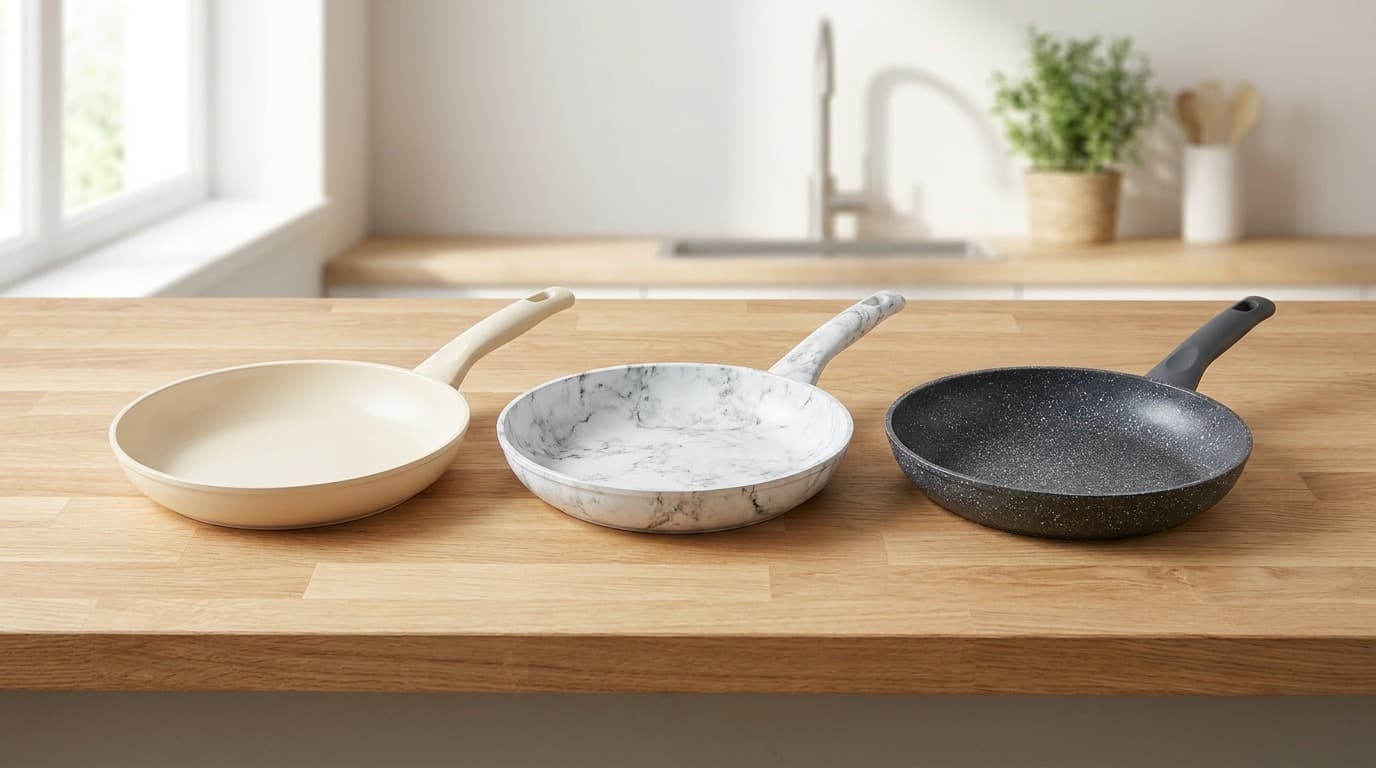
The short answer: Ceramic coatings give the smoothest food release and suit delicate cooking. Marble coatings are harder and more scratch-resistant. Granite coatings are the toughest of the three — built for heavy daily use with the longest lifespan. All three are PFOA-free.
You're standing in front of a cookware display — or scrolling through product pages at midnight — and you keep seeing the same three words. Ceramic. Marble. Granite. They all look premium. They all claim to be non-stick. But what actually makes them different?
Most product descriptions won't tell you. They'll say "ultra-durable" or "superior food release" without explaining why.
We manufacture all three coating types at Klonberg. So here's the honest version — what each coating is actually made of, how it behaves in a real kitchen, and which one makes sense for you.
First — What Are These Coatings Actually Made Of?
Here's something most people don't know: none of these coatings contains actual ceramic, marble, or granite in any meaningful quantity. The names describe how the coating looks and how it's constructed — not what it's made from.
- Ceramic is a silica-based (sand-derived) compound applied in a sol-gel process. It creates an ultra-smooth, almost glass-like surface.
- Marble is a reinforced coating — typically PTFE-based or hybrid — with mineral particles added that give the speckled marble appearance and extra surface hardness.
- Granite is a multi-layer coating — usually 3 to 5 layers — reinforced with granite-effect mineral particles. The extra layers are what make it significantly more durable than the other two.
All three are PFOA-free and food-safe. For independent verification of the safety of cookware coatings, see the European Food Safety Authority guidelines on food-contact materials.
Ceramic — The Smoothest Surface, The Most Delicate
What it feels like to cook with
If you've ever cooked an egg on a truly good non-stick pan and watched it slide off without any effort, that was probably a ceramic coating. The silica surface is incredibly smooth — almost frictionless. It needs barely any oil and releases delicate foods like nothing else.
Where it struggles
That smoothness comes at a cost. Ceramic is the most sensitive coating of the three. It starts degrading above 260°C — and most gas hobs on full power get there in under two minutes. It's also the most vulnerable to thermal shock, metal utensils, and dishwasher detergent.
With good care, it lasts 1–5 years. Push it too hard, and you'll see performance drop within months.
How to tell if ceramic is right for you
You regularly cook eggs, fish, pancakes, or crêpes. You're careful with your cookware — you already use silicone utensils and hand-wash. You want the best possible food release, and you're willing to treat the pan accordingly.
- KlonBerg KB-4204 — Ceramic Non-Stick Frying Pan — silica ceramic coating, cast aluminium base, all hob types including induction
Marble — The Everyday All-Rounder
What it feels like to cook with
Marble sits in the middle ground — better food release than granite, better durability than ceramic. The mineral reinforcement creates a harder finish that handles everyday cooking without the fragility of a ceramic pan. Sauté, brown, fry — no anxiety about every degree of heat.
Where it performs best
Marble handles up to 300°C — 40°C higher than ceramic, which makes it more forgiving if you accidentally push the heat. It also tolerates more vigorous cleaning without immediate surface damage. With reasonable care, expect 2–5 years of regular use.
Best for you if:
You cook a wide variety of dishes every day and want one pan that handles most tasks without being fragile. Everything except high-heat searing.
- KlonBerg KB-3744 — 12-Piece Marble Non-Stick Set — cast aluminium, marble coating, tempered glass lids, induction compatible.
Granite — Built to Last
What it feels like to cook with
Granite coatings feel more substantial — thicker, harder, and noticeably more robust than ceramic. You don't have to think carefully about every utensil or temperature spike.
Where it performs best
Granite tolerates up to 450°C — nearly double ceramic's limit — and the 3–5 layer construction resists scratching significantly better than the other two. The extra thickness also distributes heat more evenly across the base.
With correct care, granite lasts 2–7 years of daily use. Roughly twice the lifespan of ceramic.
Best for you if:
You cook heavily and frequently, run a professional kitchen, or have gone through non-stick pans quickly before. For wholesale buyers, the longer lifespan means fewer replacements and lower cost per year.
- KlonBerg KB-8643 — Granite Non-Stick Frying Pan 24cm — granite coating inside and out, PFOA-free, induction compatible, Designed in Germany
The Numbers Side by Side
| Feature | Ceramic | Marble | Granite |
|---|---|---|---|
| Surface smoothness | ★★★★★ | ★★★★ | ★★★ |
| Scratch resistance | ★★ | ★★★★ | ★★★★★ |
| Max heat tolerance | 260°C | 300°C | 450°C |
| Typical lifespan | 1–5 years | 2–5 years | 2–7 years |
| Best for | Delicate cooking | Everyday versatility | Heavy daily use |
| Dishwasher safe | No | Limited | Limited |
| Induction compatible | Yes | Yes | Yes |
| PFOA-free | Yes | Yes | Yes |
Browse KlonBerg Non-Stick CookwareAll KlönBerg cookware is PFOA-free, designed in Germany, and compatible with all hob types, including induction. - Browse the Full KlonBerg Cookware Range For wholesale pricing, bulk orders, and distributor enquiries: - Contact Klonberg Quick Summary
KlonBerg is a cookware manufacturer and B2B kitchenware supplier. Designed in Germany. Available for wholesale and bulk purchase across Europe. |