

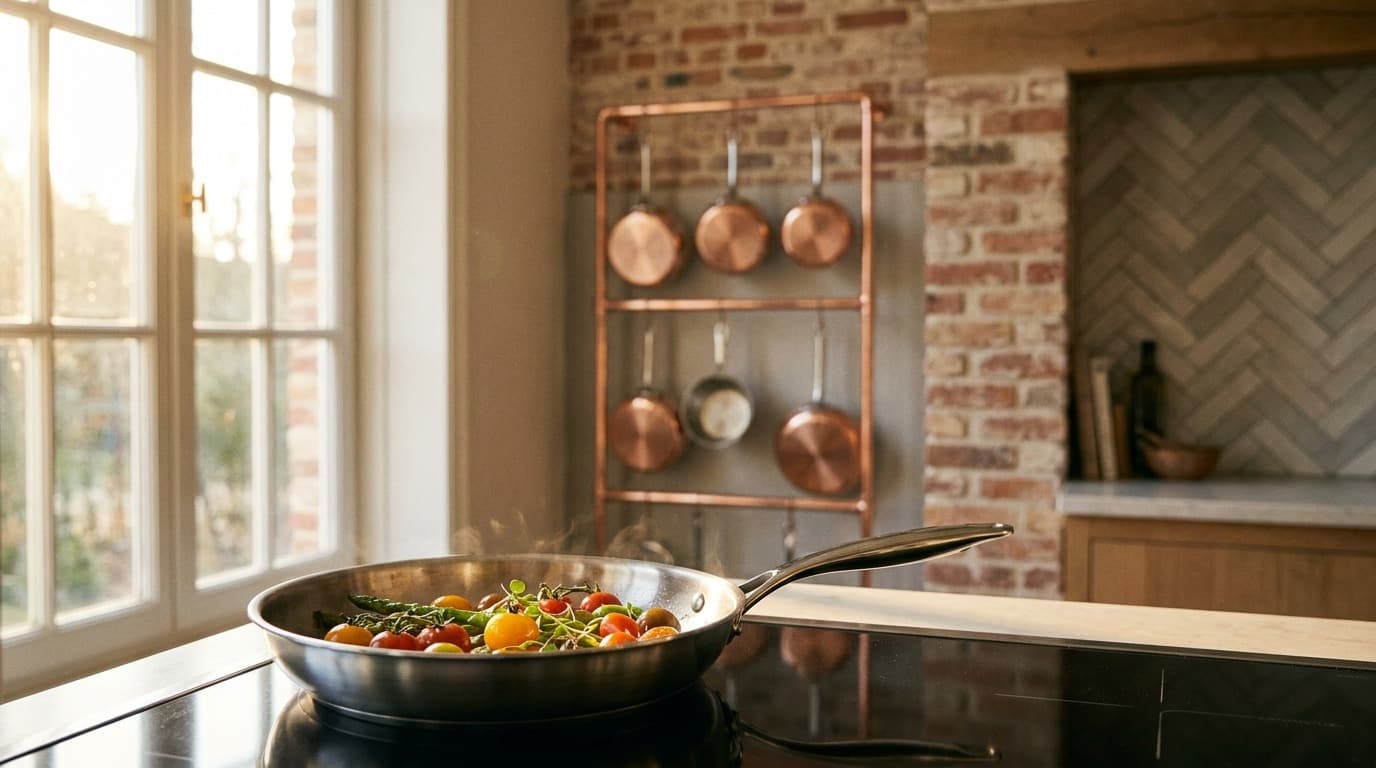
Most households should choose a 28cm frying pan. It delivers the best balance between cooking space, heat stability, and everyday usability. A 20cm pan suits single servings, a 24cm pan works well for couples, and a 32cm pan is best for batch cooking or large families.
You’re cooking dinner, and everything feels crowded again. The chicken overlaps, moisture builds up, and instead of browning, you get steam. Or you switch to a bigger pan, and suddenly the food spreads too thin and cooks unevenly.
At KlonBerg, we design cookware based on real kitchen behaviour, not catalogue numbers. One pattern shows up consistently: most cooking problems come from the wrong pan size, not the wrong technique.
This guide fixes that decision in minutes.
What Frying Pan Size Really Means
Frying pan size refers to the internal cooking diameter, not the outer edge. That difference directly affects the usable cooking surface.
Between 20cm and 32cm:
- Cooking surface increases by ~35–40%
- Heat demand increases faster than surface area
- Moisture evaporation speed changes significantly
Food needs surface contact to brown. When it overlaps, it releases steam instead of searing.
Quick diagnostic
If your food:
- steams instead of browns
- cooks unevenly in the center
- needs multiple batches for normal meals
Your pan size is likely too small.
20cm Frying Pan: Precision for Small Meals
A 20cm frying pan heats quickly due to low thermal mass. On an induction hob, it typically reaches cooking temperature (around 180°C) in about 60–90 seconds.
Best for:
- 1-person meals
- breakfast cooking
- single portions
Real cooking use:
- 1–2 eggs
- 1 small chicken breast (120–180g)
- quick vegetables or reheating
24cm Frying Pan: Everyday Balanced Choice
The 24cm pan is one of the most commonly used household sizes because it balances heat control and usable space.
Best for:
- couples
- small households
- everyday cooking
Real cooking use:
- 2–3 eggs
- 2 chicken breasts (250–350g total)
- vegetables for 2 servings
28cm Frying Pan: The Most Versatile Household Standard
The 28cm frying pan is the most flexible and widely used size in real kitchens.
It provides roughly 30% more cooking surface than a 24cm pan.
Best for:
families of 3–5
full meal cooking
mixed ingredient dishes
Real cooking use:
- 3–4 eggs or omelettes
- 3–4 chicken portions (450–600g total)
- full stir-fries or sauces
Counterintuitive insight: a 28cm pan often performs better than a 32cm pan for everyday meals because heat density stays more stable.
32cm Frying Pan: High Volume Cooking Tool
A 32cm frying pan is designed for capacity rather than daily efficiency.
Best for:
- large families (5+ people)
- meal prep cooking
- batch cooking
Real cooking use:
- 4–6 portions per cycle
- 700–900g mixed ingredients
- large protein batches
Why Size Changes Cooking Performance
Cooking performance does not scale linearly with size.
A 32cm pan has ~40% more surface area than a 24cm pan, but requires significantly more energy to maintain consistent searing temperature.
External reference:
https://www.hse.gov.uk/food-safety/cookware-safety.htm
This affects:
- heat stability
- browning speed
- energy efficiency
The Most Common Mistake
Most people assume a bigger pan equals better cooking.
But performance depends on matching pan size to portion size.
If the pan is too large:
- heat spreads unevenly
- Food browns poorly for small meals
- If the pan is too small:
- Food steams instead of searing
- Moisture builds up
Real Kitchen Usage Pattern
Most daily cooking is done in pans between 26cm and 30cm, with 28cm the most commonly used size.
Smaller pans handle quick tasks. Larger pans handle batch cooking.
But one mid-size pan usually covers most cooking.
Do You Need More Than One Frying Pan?
Most kitchens work best with two sizes:
- 24cm for quick meals
- 28cm for full cooking
KlonBerg Manufacturing Insight
At KlonBerg, we design cookware based on real usage behaviour, not theory.
From customer feedback:
- 28cm is the most used daily size
- 24cm is the most common starter size
- 32cm is used mainly for batch cooking
FINAL ADVICE
Choose your frying pan based on how much food you cook at one time, not appearance.
If you want one safe choice:
28cm is the most versatile option.
SHOP KLONBERG FRYING PANS
https://klonberg.eu/en/categories/frying-pans
https://klonberg.eu/en/contact-us